Installing a new septic system, or replacing one that's failed for good, is the highest-stakes septic decision a homeowner makes. It's also the one where getting the soil evidence right matters most, because Sedgwick County's exurban soil changes what a compliant system looks like. That starts with the permit path, runs through what the site evaluation determines, and ends with why the county's clay pushes some properties toward larger or engineered systems.
When you're in this decision
- A drain field has hydraulically failed and pumping/repair won't bring it back; see septic repair for how that diagnosis gets made.
- You're building new construction outside Wichita's sewer service area.
- You're buying a property with an aging or undocumented system and need a fresh evaluation.
The permit path in unincorporated Sedgwick County
A new or replacement system in unincorporated Sedgwick County is permitted through MABCD (the Metropolitan Area Building & Construction Department), which handles permitting and inspection for septic, lagoon, and advanced onsite systems outside city limits. Design standards statewide come from the Kansas Department of Health and Environment's Bulletin 4-2, "Minimum Standards for Design and Construction of Onsite Wastewater Systems." The general sequence, consistent with how onsite wastewater permitting works across states, runs: a site-and-soil evaluation, a system design (for alternative systems, typically by a licensed designer or engineer), a permit, installation by a licensed installer, and inspection before the system is covered. A site-and-soil evaluation is required before a new system is approved. It is not optional paperwork; it determines what kind of system the site is even allowed to have.
Why the soil evaluation matters so much here
The soil evaluation is where Sedgwick County's clay becomes a design decision rather than a footnote. Every exurban soil point in the USDA survey data rates "Very limited" for septic absorption fields, in every case limited by slow water movement through smectitic (shrink-swell) silty clay weathered from shale. A soil that percolates slowly can't accept effluent at the rate a standard gravity drain field assumes, which changes the design math directly: the allowable loading rate for clay-heavy soil is a fraction of what a sandy, fast-draining soil supports, so the same household's wastewater flow requires a much larger field on tight clay than it would on better-draining ground.
That's exactly the site condition the engineered systems below exist to handle, and it's why a poor-soil trigger matters more here than in a market with easy soil:
- A larger conventional field. The straightforward answer when soil is marginal but not disqualifying: size the field to the loading rate the soil supports.
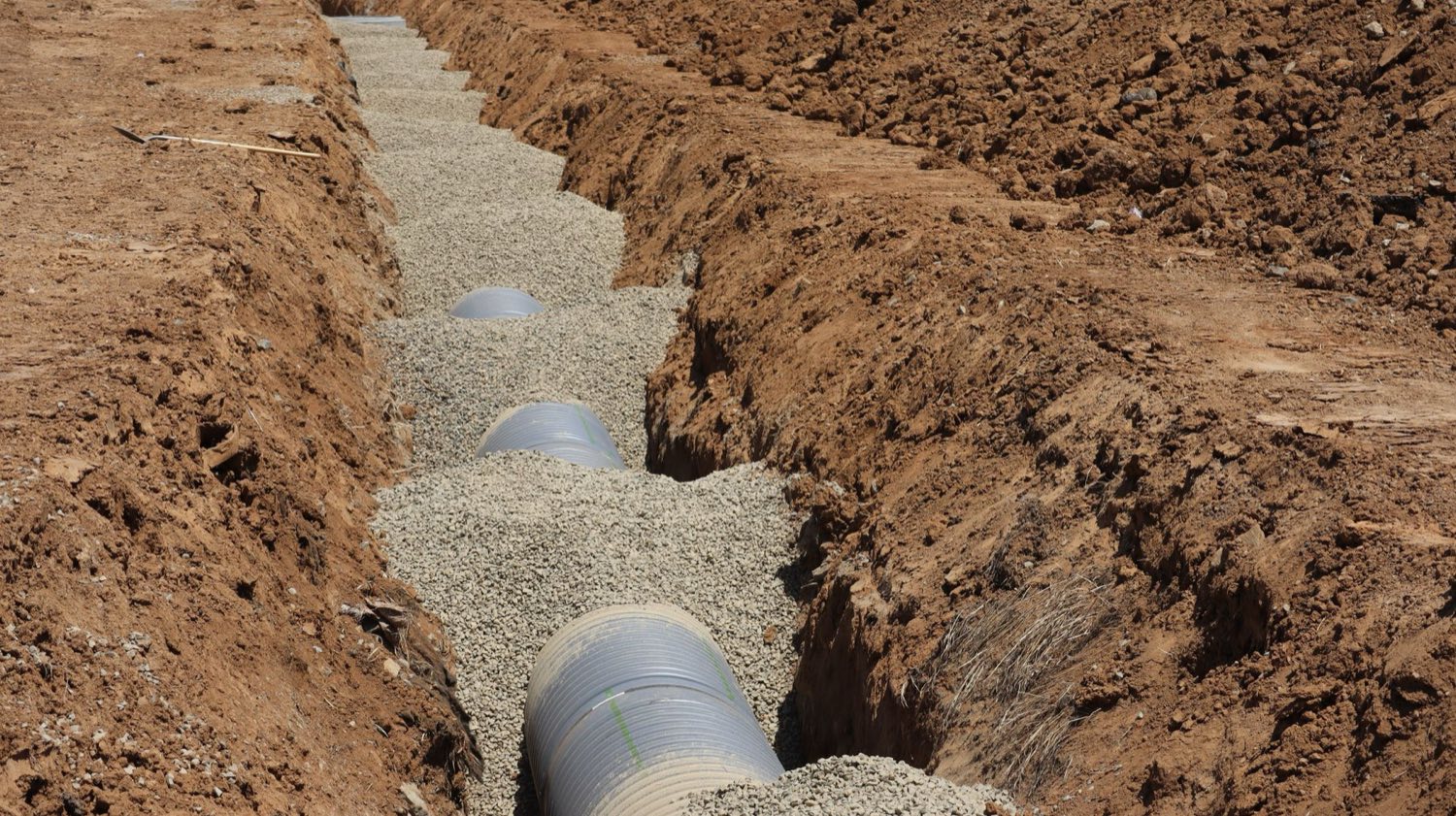
- Alternative/engineered systems for tighter conditions: a mound or at-grade system raises the field above native grade to gain separation where the soil or bedrock is limiting; an aerobic treatment unit (ATU) produces cleaner effluent so the field itself can be smaller; drip dispersal spreads effluent through shallow tubing where space or soil conditions rule out a conventional field. Each is a real EPA-recognized system type used specifically for shallow, tight, or otherwise-limited soils.
- Lagoons are common in rural Kansas for exactly this kind of soil-and-space situation, and MABCD permits them locally.
Which system a given property needs is a soil-and-site question, not a preference. The evaluation determines it, and a design that skips or shortcuts that step risks a system that's undersized or non-compliant for the ground it sits on.
Shallow bedrock is a second, related constraint
On the Rosehill soils that dominate part of the exurban ring, shale bedrock sits as shallow as roughly 3 feet below grade. Shallow bedrock is one of the standard triggers for a mound or engineered system, independent of the slow-perc issue, because it limits how much unsaturated soil depth is available for treatment before the effluent reaches a limiting layer. A site evaluation checks for this directly.
Clearance distances also shape what fits on a lot
Setback distances (how far a tank or field has to sit from a well, a property line, or surface water) are set by the state, not a federal standard, and they run tighter for a tank than for a drain field, since the field is where effluent enters the ground. Commonly cited minimums elsewhere run in the range of roughly 50 feet from a tank and 100 feet from a drain field to a private well, with wider margins near public-supply wells, plus smaller separations from property lines. The exact figures for a given Sedgwick County lot are confirmed during the site evaluation, not assumed from a national average. On a smaller or irregularly shaped exurban lot, those clearances combined with a larger loading-rate-driven field size (from the clay above) can limit which system types fit, which is part of why the evaluation, not a homeowner's guess, determines the design.
Repair vs. full replacement
Not every failed field means a whole-system replacement. If the tank is sound and only the field has failed, a new drain field on a freshly evaluated area of the lot may be enough. That still requires its own permit and soil evaluation, but it's a smaller-scope project than replacing tank and field together. A full system replacement is the highest-ticket branch, typically triggered when the existing system is failing across the board or the property is being redesigned for a different use. See septic repair for how that determination gets made in the first place.
What it costs
Costs for installation and replacement vary enormously depending on the soil evaluation, the system type the site requires, and the scope of the work: a conventional gravity system on a decent site costs meaningfully less than an engineered alternative system on a tight or shallow-bedrock lot. See septic costs for how to think about the number and why any figure quoted here is a typical range, never a fixed quote.
Related: why septic fields fail in Wichita for the fuller soil and climate picture, and septic tank pumping for the maintenance that protects a new system once it's in.